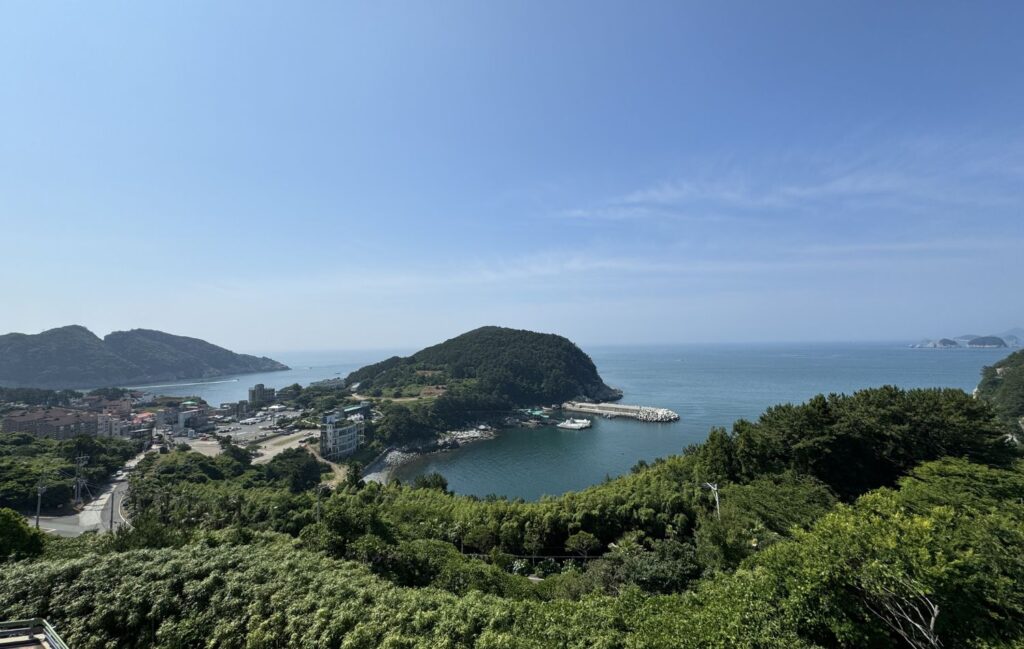
South Korea’s coastal geography rewards the traveler who looks past the obvious. Jeju gets the flights, the resorts, and the itinerary slots in every guidebook. But Geoje Island, sitting quietly off the southern tip of the peninsula with a bridge connection to Busan and a coastline that puts most famous destinations to shame, has been quietly building a reputation among travelers who have done Jeju and want something with more texture.
This guide focuses on the southern coast of Geoje the stretch between Hakdong and Haegumgang where the island’s best scenery, most interesting food, and most sought-after accommodation are concentrated.
Why the Southern Coast of Geoje Deserves Your Attention
The southern coast of Geoje is geologically unlike most of Korea’s coastal areas. Where the east coast offers long sandy beaches and the west coast presents tidal flats, the southern edge of Geoje is made of hard volcanic rock that has been cut, shaped, and hollowed by the Korea Strait over centuries. The result is a coastline of dramatic cliffs, sea caves, narrow channels, and rock formations that glow amber in the morning light.
This is not a coast for beach days. It is a coast for boat tours, coastal walks, long dinners of fresh seafood at harbor restaurants, and the particular satisfaction of waking up in a private villa with nothing visible through the window except water and rock.
The area has developed accordingly. The accommodation options near Haegumgang now include some of the finest private villa-style pensions in the country standalone buildings with outdoor pools, ocean-facing terraces, and the kind of complete privacy that urban travelers specifically seek out when they decide they need to properly rest.
Haegumgang: The Formation That Anchors the Region
Haegumgang is the reason most visitors come to Geoje’s southern coast, and it earns the attention. The formation stretches for roughly two kilometers along the island’s southeastern edge, presenting an almost unbroken wall of layered volcanic columns that descend directly into the sea.
The standard approach is the boat tour from Galpo Port. These 40-minute circuits depart throughout the day and travel close enough to the rock faces to convey their scale some sections rise 15 meters above sea level, with the water below running fast and green through narrow channels. On clear mornings, the views extend past the formation toward the open strait and, on exceptional days, toward the faint outline of Tsushima Island off the Japanese coast.
The land-based walking path above the formation provides a complementary view. It runs for approximately two kilometers, with several elevated rest points offering perspectives unavailable from the water. The walk takes about an hour at a relaxed pace and is suitable for most fitness levels.
The best time to visit Haegumgang is early morning, when the light is low and the tour boats have not yet filled. The formations catch the sunrise at an angle that turns the layered rock faces deep orange a color that photographs well but is better appreciated in person, without the need for a camera at all.
The Villages: Galpo and Hakdong
Galpo functions as the service hub for the Haegumgang area. The harbor is the departure point for the boat tours, and a row of seafood restaurants along the approach road provides straightforward, reliable food within walking distance of the port. The village itself is small perhaps 20 minutes to walk end to end and retains the character of a working fishing community despite the volume of visitors it receives each year.
The fish available directly from vendors at the harbor is caught locally and sold at prices that would surprise anyone accustomed to buying seafood in the city. Several restaurants will cook purchased fish for a modest preparation fee, which makes for one of the more satisfying and affordable meals on the island.
Hakdong is a quieter stop a few kilometers east of Galpo, distinguished primarily by its pebble beach. The beach is composed of smooth, rounded stones rather than sand a texture that produces a distinctive sound when the waves draw back across it. The beach is popular for early morning walks and is one of the two main departure points for ferries to Oedo Botania.
Oedo Botania: The Unexpected Garden Island
Oedo is one of those places that is difficult to describe without sounding either dismissive or overclaiming. It is a rocky island eleven kilometers offshore that a private couple spent four decades transforming into a botanical garden. The result is dense, organized, somewhat theatrical, and genuinely impressive.
The garden covers the entirety of the island’s usable surface in over 3,000 plant species arranged into themed sections a rose garden, a Mediterranean terrace, a cactus greenhouse, open platforms with 360-degree sea views. The visual effect is layered and rich, particularly in spring when the flowering plants are at peak bloom.
The ferry crossing from Hakdong or Wahyeon Port takes approximately 25 minutes. The garden warrants 90 minutes to two hours for a proper visit. Boats return throughout the day, so there is no pressure to rush.
Where to Stay: Accommodation Near Haegumgang
The accommodation landscape near Haegumgang has shifted significantly over the past decade toward private villa-style pensions. These are standalone buildings typically designed for a single group at a time with private outdoor pools, covered terraces, and views oriented toward the sea or the surrounding hillsides.
For travelers researching options, the official tourism listings at tour.geoje.go.kr provide a reliable starting point for finding registered and verified accommodation in the area.
The most desirable properties in this area book out quickly during summer weekends and public holiday periods. Planning visits during the spring (April to May) or autumn (September to October) shoulder seasons significantly improves availability and often reduces nightly rates.
A few practical notes:
Reaching most private villa accommodations near Haegumgang requires a car. The hillside roads that lead to the better-positioned properties are not served by public transport, and the distances between attractions along the southern coast make car rental a practical necessity for anyone spending more than a few hours in the area.
Properties with heated pools charge a supplement typically around 70,000 to 100,000 won per stay depending on season and property type. This is worth confirming at the time of booking rather than discovering at check-in.
Check-in times at most pensions in this area are from 3pm, with checkout at 11am. Late check-ins after 8pm typically require advance notice.
Food on the Southern Coast
The food culture of Geoje’s southern coast is defined by the sea and by the directness of a community that has been fishing these waters for generations. Restaurant menus are not designed around tourist expectations; they reflect what is caught, what is in season, and what local people actually eat.
A few dishes that appear consistently across the area’s restaurants:
Godeungeo (grilled mackerel) is the most reliable indicator of a kitchen’s quality. Mackerel is split, salted, and grilled over charcoal or gas until the skin is crisp and the flesh just cooked through. It is a simple dish that is nonetheless difficult to do well consistently, and a restaurant that does it well can be trusted with everything else on the menu.
Hoe (sliced raw fish) is served Korean-style with a spread of accompaniments fermented soybean paste, fresh chilies, sesame oil, perilla leaves, and green onion. The flatfish, sea bream, and flounder from these waters are particularly clean in flavor. First-time visitors occasionally find the portion sizes intimidating; ordering for two people typically produces food for three.
Haemultang (spicy seafood stew) is a one-pot dish of mixed shellfish, fish, and vegetables in a chili broth that is best eaten in autumn and winter when the seafood is at its richest. Several restaurants near Galpo specialize in this dish.
Most restaurants in the area do not require reservations for weekday lunches. Weekend dinner during summer requires either an early arrival or advance booking at the more established places.
Getting There and Getting Around
- By car from Busan:
- The Geoga Bridge connects the mainland to Geoje directly, with a total crossing of approximately 8.2 kilometers over the bay. From the bridge toll plaza to the Haegumgang area takes approximately 50 minutes, depending on traffic near Gohyeon.
- By bus from Busan:
- Direct services run from Busan Seobu Bus Terminal to Gohyeon in approximately one hour. From Gohyeon, local buses reach Hakdong and the road toward Haegumgang, but services are infrequent. A taxi from Gohyeon to Haegumgang costs approximately 25,000 to 30,000 won.
- On the island:
- Rental car is the most practical option for anyone focused on the southern coast. Several agencies operate near Gohyeon Terminal, and the roads toward Haegumgang, while narrow in places, are well-maintained. Parking is available at the main attraction points and at most private villa accommodations.
When to Visit
Each season on Geoje’s southern coast has a distinct character:
- Spring (April–May):
- Mild temperatures, canola and cherry blossom season, smaller crowds. The most broadly recommended window for first-time visitors.
- Summer (June–August):
- Warm and humid. Peak season, with significantly higher accommodation prices and reduced availability at better properties near Haegumgang. Worth visiting but requires advance planning.
- Autumn (September–October):
- Excellent weather, peak seafood quality, autumn color in the hillsides. Comparable to spring in terms of conditions, with the addition of better food.
- Winter (November–March):
- Cold, quiet, significantly cheaper. Some attractions reduce hours. The coastline takes on a spare, atmospheric quality that has its own appeal for travelers comfortable with cold weather.
A Final Note
Geoje’s southern coast is the kind of place that improves with each visit. First-time visitors tend to focus on Haegumgang and leave satisfied but slightly rushed. Those who return know to slow down to spend a morning on the boat and an afternoon on the walking path, to eat lunch at the harbor and dinner somewhere with no English menu, to arrive at the accommodation early enough to watch the light change over the water before the day ends.
The island does not reward hurrying. It rewards attention, and it gives back in proportion to what you bring to it.